Ebook Free Stochastic Calculus for Finance I: The Binomial Asset Pricing Model (Springer Finance) (v. 1)
From the title, we will additionally show you the topic pertaining to explain. When you actually need this kind of resource, why don't you take it currently? This publication will not only give you the knowledge as well as lesson about the topic, from the words that are utilized, it specify brand-new fun point. This Stochastic Calculus For Finance I: The Binomial Asset Pricing Model (Springer Finance) (v. 1) will certainly make you really feel no concern to invest even more time in analysis.
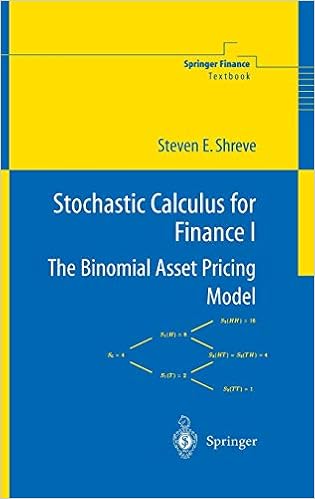
Stochastic Calculus for Finance I: The Binomial Asset Pricing Model (Springer Finance) (v. 1)

Ebook Free Stochastic Calculus for Finance I: The Binomial Asset Pricing Model (Springer Finance) (v. 1)
Stochastic Calculus For Finance I: The Binomial Asset Pricing Model (Springer Finance) (v. 1) When creating can alter your life, when writing can enrich you by supplying much cash, why do not you try it? Are you still extremely confused of where getting the ideas? Do you still have no idea with what you are going to write? Now, you will need reading Stochastic Calculus For Finance I: The Binomial Asset Pricing Model (Springer Finance) (v. 1) A great writer is a good reader simultaneously. You can define how you create depending on just what books to read. This Stochastic Calculus For Finance I: The Binomial Asset Pricing Model (Springer Finance) (v. 1) can help you to address the problem. It can be among the right resources to develop your composing skill.
To conquer the problem, we now provide you the modern technology to purchase guide Stochastic Calculus For Finance I: The Binomial Asset Pricing Model (Springer Finance) (v. 1) not in a thick printed file. Yeah, reviewing Stochastic Calculus For Finance I: The Binomial Asset Pricing Model (Springer Finance) (v. 1) by on the internet or getting the soft-file simply to read could be among the means to do. You might not really feel that checking out a publication Stochastic Calculus For Finance I: The Binomial Asset Pricing Model (Springer Finance) (v. 1) will certainly work for you. But, in some terms, May people successful are those who have reading routine, included this type of this Stochastic Calculus For Finance I: The Binomial Asset Pricing Model (Springer Finance) (v. 1)
Reviewing most definitely this book could produce the specific need and also severe ways to go through and conquer this issue. Book as a window of the world can have the exact circumstance of just how this publication exists. Stochastic Calculus For Finance I: The Binomial Asset Pricing Model (Springer Finance) (v. 1) as we suggest being prospect to check out has some breakthroughs. Besides it is viewed from exact same subject as you require, it has likewise intriguing title to read. You could also see just how the design of the cover is stylised. They are truly well done without frustration.
It's no any kind of faults when others with their phone on their hand, as well as you're also. The difference might last on the material to open up Stochastic Calculus For Finance I: The Binomial Asset Pricing Model (Springer Finance) (v. 1) When others open the phone for talking and speaking all points, you can sometimes open up as well as review the soft documents of the Stochastic Calculus For Finance I: The Binomial Asset Pricing Model (Springer Finance) (v. 1) Of course, it's unless your phone is offered. You can additionally make or wait in your laptop or computer that alleviates you to check out Stochastic Calculus For Finance I: The Binomial Asset Pricing Model (Springer Finance) (v. 1).
Review
Steven Shreves comprehensive two-volume Stochastic Calculus for Finance may well be the last word, at least for a while, in the flood of Masters level books.... a detailed and authoritative reference for quants (formerly known as rocket scientists). The books are derived from lecture notes that have been available on the Web for years and that have developed a huge cult following among students, instructors, and practitioners. The key ideaspresented in these works involve the mathematical theory of securities pricing based upon the ideas of classical finance....the beauty of mathematics is partly in the fact that it is self-contained and allows us to explore the logical implications of our hypotheses. The material of this volume of Shrevess text is a wonderful display of the use of mathematical probability to derive a large set of results from a small set of assumptions.In summary, this is a well-written text that treats the key classical models of finance through an applied probability approach. It is accessible to a broad audience and has been developed after years of teaching the subject. It should serve as an excellent introduction for anyone studyin the mathematics of the classical theory of finance.-- SIAM, 2005From the reviews of the first edition: Steven Shreve??'s comprehensive two-volume Stochastic Calculus for Finance may well be the last word, at least for a while, in the flood of Master??'s level books.... a detailed and authoritative reference for "quants??? (formerly known as "rocket scientists???). The books are derived from lecture notes that have been available on the Web for years and that have developed a huge cult following among students, instructors, and practitioners. The key ideaspresented in these works involve the mathematical theory of securities pricing based upon the ideas of classical finance. ...the beauty of mathematics is partly in the fact that it is self-contained and allows us to explore the logical implications of our hypotheses. The material of this volume of Shreves??'s text is a wonderful display of the use of mathematical probability to derive a large set of results from a small set of assumptions. In summary, this is a well-written text that treats the key classical models of finance through an applied probability approach. It is accessible to a broad audience and has been developed after years of teaching the subject. It should serve as an excellent introduction for anyone studyin the mathematics of the classical theory of finance. -- SIAM, 2005 "This is the first of the two-volume series evolving from the author??'s mathematics courses in M.Sc. Computational Finance program at Carnegie Mellon University (USA). The content of this book is organized such as to give the reader precise statements of results, plausibility arguments, mathematical proofs and, more importantly, the intuitive explanations of the financial and economic phenomena. Each chapter concludes with summary of the discussed matter, bibliographic notes, and a set of really useful exercises." (Neculai Curteanu, Zentralblatt MATH, Vol. 1068, 2005)From the reviews of the first edition: Steven Shrevea (TM)s comprehensive two-volume Stochastic Calculus for Finance may well be the last word, at least for a while, in the flood of Mastera (TM)s level books.... a detailed and authoritative reference for "quantsa (formerly known as "rocket scientistsa ). The books are derived from lecture notes that have been available on the Web for years and that have developed a huge cult following among students, instructors, and practitioners. The key ideaspresented in these works involve the mathematical theory of securities pricing based upon the ideas of classical finance. ...the beauty of mathematics is partly in the fact that it is self-contained and allows us to explore the logical implications of our hypotheses. The material of this volume of Shrevesa (TM)s text is a wonderful display of the use of mathematical probability to derive a large set of results from a small set of assumptions. In summary, this is a well-written text that treats the key classical models of finance through an applied probability approach. It is accessible to a broad audience and has been developed after years of teaching the subject. It should serve as an excellent introduction for anyone studyin the mathematics of the classical theory of finance. -- SIAM, 2005 "This is the first of the two-volume series evolving from the authora (TM)s mathematics courses in M.Sc. Computational Finance program at Carnegie Mellon University (USA). The content of this book is organized such as to give the reader precise statements of results, plausibility arguments, mathematical proofs and, more importantly, the intuitive explanations of the financial andeconomic phenomena. Each chapter concludes with summary of the discussed matter, bibliographic notes, and a set of really useful exercises." (Neculai Curteanu, Zentralblatt MATH, Vol. 1068, 2005)
Read more
From the Back Cover
Stochastic Calculus for Finance evolved from the first ten years of the Carnegie Mellon Professional Master's program in Computational Finance. The content of this book has been used successfully with students whose mathematics background consists of calculus and calculus-based probability. The text gives both precise statements of results, plausibility arguments, and even some proofs, but more importantly intuitive explanations developed and refine through classroom experience with this material are provided. The book includes a self-contained treatment of the probability theory needed for stchastic calculus, including Brownian motion and its properties. Advanced topics include foreign exchange models, forward measures, and jump-diffusion processes. This book is being published in two volumes. The first volume presents the binomial asset-pricing model primarily as a vehicle for introducing in the simple setting the concepts needed for the continuous-time theory in the second volume. Chapter summaries and detailed illustrations are included. Classroom tested exercises conclude every chapter. Some of these extend the theory and others are drawn from practical problems in quantitative finance. Advanced undergraduates and Masters level students in mathematical finance and financial engineering will find this book useful. Steven E. Shreve is Co-Founder of the Carnegie Mellon MS Program in Computational Finance and winner of the Carnegie Mellon Doherty Prize for sustained contributions to education.
Read more
Product details
Series: Springer Finance
Paperback: 208 pages
Publisher: Springer; 2004 edition (April 21, 2004)
Language: English
ISBN-10: 0387401008
ISBN-13: 978-0387401003
Product Dimensions:
6.1 x 0.5 x 9.2 inches
Shipping Weight: 1 pounds (View shipping rates and policies)
Average Customer Review:
4.1 out of 5 stars
33 customer reviews
Amazon Best Sellers Rank:
#151,273 in Books (See Top 100 in Books)
I have the 1st version (pdf), so I hesitated before I make the purchase. Now it turns out that the book is worthy every buck.1. Use coin tossing space consistently as working sample. Very intuitive, never get the idea lost in abstract concepts.2. Detailed workout of examples. Very good for self study.3. Plenty of hands-on homeworks. Not necessarily very challenging. But provide good amount of extra examples.If anything the book can add, I hope it can supply implementations, in Matlab or C++. Well, it may be far stretching for a math book.
Shreve's book is an excellent introduction to basic options pricing. He not only deals with plain vanilla options, but also shows how the binomial model can be used to to value exotic options. Each chapter has exercises which not only apply what is taught but force you to think and ensure that you really understand it.Little more than basic algebra is required to understand the text, making it very accessible. His expositions of topics such as martingales, markov processes, etc. are very good. The text can be dense, though--there's a great deal of information.In short, if you want an introduction of how options can be priced without the partial differential equations in the Black-Scholes model, this is an excellent choice.
Constantly rereading to gain understanding of the book's explanation of simple conconcept. Despite, I like it
i have read so many books on financial engineering but this one makes all theories so streamlined!!! I read Neftci and I liked it. After reading this, all steps come out clear. The part 2 is fascinating as well. Hail Mugambo!
very good
The second part has much more to tell. and although based on the first part, could be studied separately. The first part is still a decent foundation for interested readers.
It's great book.
It would be hard to overstate my enthusiasm for this text and its companion volume. In field that is too frequently represented by poorly thought out drafts rushed to market or by advanced mathematical treatments that are not easily understood by individuals more focused on practice, Shreve's texts stand out by being both rigorous and accessible with well thought out examples and exercises.This particular volume, covering binomial models, covers advanced concepts in a discrete setting. For some it will represent a waste of time and those individuals are best advised to skip to Volume II. However, many intelligent students who are not so comfortable with abstract mathematics will find this a simple and concrete exposition that can serve as a bridge to more advanced theory.
Stochastic Calculus for Finance I: The Binomial Asset Pricing Model (Springer Finance) (v. 1) PDF
Stochastic Calculus for Finance I: The Binomial Asset Pricing Model (Springer Finance) (v. 1) EPub
Stochastic Calculus for Finance I: The Binomial Asset Pricing Model (Springer Finance) (v. 1) Doc
Stochastic Calculus for Finance I: The Binomial Asset Pricing Model (Springer Finance) (v. 1) iBooks
Stochastic Calculus for Finance I: The Binomial Asset Pricing Model (Springer Finance) (v. 1) rtf
Stochastic Calculus for Finance I: The Binomial Asset Pricing Model (Springer Finance) (v. 1) Mobipocket
Stochastic Calculus for Finance I: The Binomial Asset Pricing Model (Springer Finance) (v. 1) Kindle

0 comments:
Post a Comment